god’s river
by Billy Ray Belcourt
it is september 2009 and health canada sends body bags to god’s river first nation—a community hit hard by swine flu
a body bag
is a gun
is a smallpox blanket
is a treaty
—call it a medicine chest
wait for
the autopsy
they call it H1N1
you call it
the pass system:
bodies like
these can
only leave if
they’re on
stretchers
—call it “moving”
Adapting the Indian in the Child: The Settler Colonial Politics of Adopting Native American Children
by Joshua Whitehead
In June of 2015, Manitoba became the first province to apologize to survivors of Canada’s Sixties Scoop. For those unfamiliar, the Sixties Scoop refers to the removal of Indigenous children from their families, “scooping” them up, and placing them into foster homes with non-Indigenous families and/or residential/day schools. I also deploy the term Sixties Scoop with an awareness of its expansive and evolutionary nature, in that it branches beyond the sixties and moves well into the eighties; moreover, its remnants can be seen in Canada’s contemporary Child and Family Services (CFS). In light of the Truth and Reconciliation Commission (TRC), Manitoba’s apology was a first step towards reconciling with survivors. As the child of a Sixties Scoop survivor, I am interested in how adoption functions within the larger framework of North American settler colonial practices[1]. While there is quite a bit of research on the effects of adoption on adoptees and their parents, what I am interested in exploring for the purposes of this essay is the effects/affects of adoption from an intergenerational and intercommunal perspective. I ask: how does adoption of Indigenous children away from their communities and relations harm Indigeneity intergenerationally? How does the adoptive child fit into his/her/their community and moreover, how is the community kinship impinged through adoptive practices? I want to place my research findings and personal experiences in tandem with the recent film, Drunktown’s Finest, in an attempt to question how adoption of Indigenous children away from their communities impinges entire Indigenous communities as a tool of settler colonialism.
The Enduring Rhythm of Ngũgĩ wa Thiong’o
by Josh Myers
The African future. Many have mused about its meaning. Many have predicted its possibilities. Few have considered its philosophical basis. Even fewer have considered its spiritual foundation.[1] What will be the moral compass that guides the African future? Who will determine what is good for Africa? For Africans? For those willing to answer these questions in ways that privilege the humanity and cultural authority of African peoples, for those unwilling to subject the African future to the whims of those who would answer these questions from political cultures beholden to the traditional sources of African doom—above all capital, and for those whose orientation is guided by what Anderson Thompson once called “the African principle,”[2] we cannot begin to answer these questions without a deep engagement with the intellectual work of the Kenyan writer, Ngũgĩ wa Thiong’o.
Among the most significant literary and cultural voices among an expansive tradition of Pan-African “Grand Theorists,”[3] his work continues to powerfully resonate for African peoples unwilling and unable to submit to the cultural imperialism of those who believed that capitalist modernity was and is an irrevocable leap forward for humanity. At the core of this contribution has been the idea that the political projects regnant of the freedom dreams of African peoples must in fact be grounded in the cultural identity of those for whom freedom is to be won. The study of African languages as more than simply an anthropological relic, but as the recovery and use of such languages as carriers of what it means to be—to be free— has guided and continues to guide this oeuvre. For decades Ngũgĩ’s writings have kept this consistent rhythm, and the beat goes on. It carries the logic of resistance, of renaissance.[4]
#DecolonizeWaterPolitics
Today we are tweeting with the hashtag #DecolonizeWaterPolitics to discuss the politics of water worldwide! We want everyone to join the conversation: to talk, understand, report, and tweet about re-envisioning and decolonizing how we understand water and our relationships to it. Join us March 24, 2016. Share news stories that you think express Indigenous ideas, share your own thoughts on decolonizing water politics, and let everyone know why we need to #DecolonizeWaterPolitics .
Reconciliation and Mandatory Indigenous Content Courses: What are the University’s Responsibilities?
by Rauna Kuokkanen
I fully agree with everyone who argues that Canadian university students do not know enough about Indigenous peoples and their societies, histories, political orders and worldviews or systems of knowledge. Yet, I’m wary of the growing chorus of calls for mandatory courses on Indigenous issues in Canadian universities. I fear we as Indigenous scholars and educators are selling ourselves short. Especially for universities that have not shown serious and long-standing commitment to Indigenous studies and scholarship, mandatory courses are an easy way out.
A lot has been written on both the pros and cons of mandatory courses on Indigenous peoples and the logistics of designing, implementing and teaching such courses: who is going to teach the courses, under which unit with what kind of financial and human resources available (see, Gaudry; Justice; and McDonald). I share these and other concerns about how to ensure the courses will meet the intended objectives instead of end up being counterproductive and backfiring, especially on Indigenous students and faculty.
My fundamental unease, however, has to do with the obstinate refusal of the academy to go beyond relatively shallow changes in the curriculum and to address its academic practices and discourses that enable the continued exclusion of other than dominant Western epistemic and intellectual traditions. Reconciliation becomes a quick-fix solution or an item on a list, which once checked, needs no further consideration or attention.
We Be, Therefore, I Struggle
by Alex Abbasi
Decolonization
Is more than a verb
Noun, adjective or word
It is a particle
An atom of light
Jihad
Bursting
Sometimes fast, sometimes shadowed
From the depths of darkness
Sharper than a sword
Swearing to one’s Lord
¡Allahu Akbar!
the sound from here
by Nadia Rhook
over there
colonisation sounds like business
I can hear money tinkling
Got change? Yeah, nufor a latte anyways
from the universe-ity it’s
empires, eroding my ears, by overlapping waves
Si, me encanta este ciudad
But y’now she’s got issues like the rest of them
but from here
colonisation is quiet
squatting on my front porch
the Dandenongs are mountain ranging
children dart up this path on bikes
I hear them scoot away
the trickle of water on a spongy garden bed
in an arrangement, signed & unspoken, we
rent this place and water the roses when we remember
from this porch settler colonialism sounds easy
like suburbia
the question, not how can that be? but
how long til it sounds different
Nadia Rhook lectures and researches history at Latrobe University, on the Wurundjeri land of the Kulin nations. Her PhD explored the aural dimensions of migration and colonialism in Melbourne. She’s concerned with the decolonisation of language(s), and is co-curating a heritage exhibition, ‘Moving Tongues: language and difference in 1890s Melbourne’, to show in October 2016.
Everything to Lose: The Settler Colonial Stakes of The Revenant
by K2
One thing is crystal clear from 20th Century Fox’s new blockbuster hit The Revenant: settler lives matter. Hugh Glass, the 19th century American frontiersman played by Leonardo DiCaprio, is so incredibly immune to death that he rises from his own grave after having been torn to shreds by a grizzly at the film’s outset. The signature series of shots that every spectator is sure to remember – DiCaprio’s own breath fogging up the camera lens as he stares down its chamber – constitutes such an essential element of the film’s aesthetic that one is led to believe that Leonardo’s own life (or maybe just his Oscar) is on the line. My claim, then, is that The Revenant is first and foremost a story of settler survival and is therefore not without its settler colonial stakes.

“This olive tree that prays to God, what did it do?”: On the BDS Campaign and Israel
On February 18, 2016, the Conservative Party of Canada proposed a parliamentary motion[i]:
That, given Canada and Israel share a long history of friendship as well as economic and diplomatic relations, the House reject the Boycott, Divestment and Sanctions (BDS) movement, which promotes the demonization and delegitimization of the State of Israel, and call upon the government to condemn any and all attempts by Canadian organizations, groups or individuals to promote the BDS movement, both here at home and abroad.
The Liberals have said they will support it in a vote, which will be held on February 22, 2016.[ii] [Editor’s note: The proposed motion was passed on Feb. 22 by a vote of 229-51] As a person with Jewish ancestry living in Canada, I felt compelled to respond, but my own words proved insufficient to the task. Instead, I have produced a collage of others’ words to craft a story, the collective impact of which far exceeds anything I could produce alone. All italics are direct quotations; the full list of sources is in the endnotes, and links to the original sources are provided where possible. Non-italicized parts are my own words (to the extent that anything is ever our own).
* * *
‘i’m not that kind of jew,’ she says. ‘ok,’ I said, ‘me neither.’
“Zionist” has become the hateful code word for “Jew”.[iii]
We are alarmed by the extreme, racist dehumanization of Palestinians in Israeli society, which has reached a fever-pitch…we are disgusted and outraged by Elie Wiesel’s abuse of our history in these pages to justify the unjustifiable: Israel’s wholesale effort to destroy Gaza and the murder of more than 2,000 Palestinians, including many hundreds of children. Nothing can justify bombing UN shelters, homes, hospitals and universities. Nothing can justify depriving people of electricity and water.[iv]
The rise of anti-Israel and anti-Jewish activities in academia begs for an effective strategy to prepare Jewish students to fight BDS on college campuses before they go to college. Getting Jewish teens to Israel en masse, combined with Israel advocacy training in local communities before they go to college, is the only shot we have to build an army of ‘boots on the ground’ on college campuses.[v]
It is especially painful for left-leaning Jewish-Israelis, because we believe so wholeheartedly that we already know about inequality, how bad it is and what should be done about it.[vi]
are we the Chosen People? to wit: ‘As a Jew, I have a responsibility to defend Israel – its Jewish demographic advantage, and its right to defend itself from Palestinian threats.’ ‘As a Jew, I have a responsibility to critique Israel and support Palestine, based on both Jewish values, and given what happened to us in the Shoah.’ two sides, same coin? Read more…
On the spatial and temporal intersectionality of freedom movements: A review of Angela Davis’ “Freedom is a Constant Struggle”
by Eric Ritskes
Angela Y. Davis (2016). Freedom is a Constant Struggle: Ferguson, Palestine, and the Foundations of a Movement. Chicago, IL: Haymarket Books. ** 158 pp. **
I want to emphasize the importance of approaching both our theoretical explorations and our movement activism in ways that enlarge and expand and complicate and deepen our theories and practices of freedom. (p. 104)
The title of the newest entry in Angela Davis’ body of work, Freedom is a Constant Struggle, simultaneously evokes both resignation and hope, both critique and inspiration. And, as Davis looks back at her decades of involvement in Black, global freedom movements, as well as at the futures of these movements, these tensions are apparent.
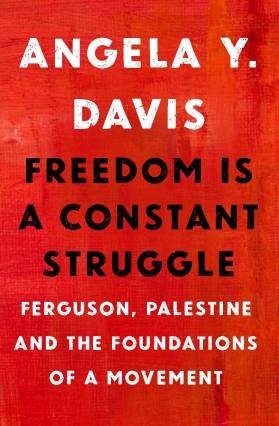 For those who are familiar with and follow Davis’ recent work, this book – drawn from a series of interviews with Frank Barat, and from a few of her recent speeches – provides little new content. Its accessible style and format is wide ranging in topic, especially in the early chapters drawn from the interviews, and at times the conversation feels disjointed; in part, owing to interview questions which jump around, often without transition, from Palestine to prison abolition to Black power to Obama to feminism. Each individual topic unto itself is underdeveloped, limited by space and format.
Yet, taken as a whole, the book offers a clarion call to our various freedom movements; it is a necessarily urgent call for the intersectionality needed to foster and grow organized grassroots movements against global oppression and terror. As Davis emphasizes a number of times throughout the book, this book is a call for “not so much intersectionality of identities, but intersectionality of struggles” (p. 144). In connecting Ferguson and other Black radical struggles to Palestine (primarily), she expansively opens up her book as a discussion on what it will take to end racism and colonialism and patriarchy, what it will take to abolish prisons, value transgender people, and end the death penalty in the United States. As she writes, in regards to these diverse issues: “They [aren’t] separate in our bodies, but also they are not separate in terms of struggle” (p. 19).

 Decolonization